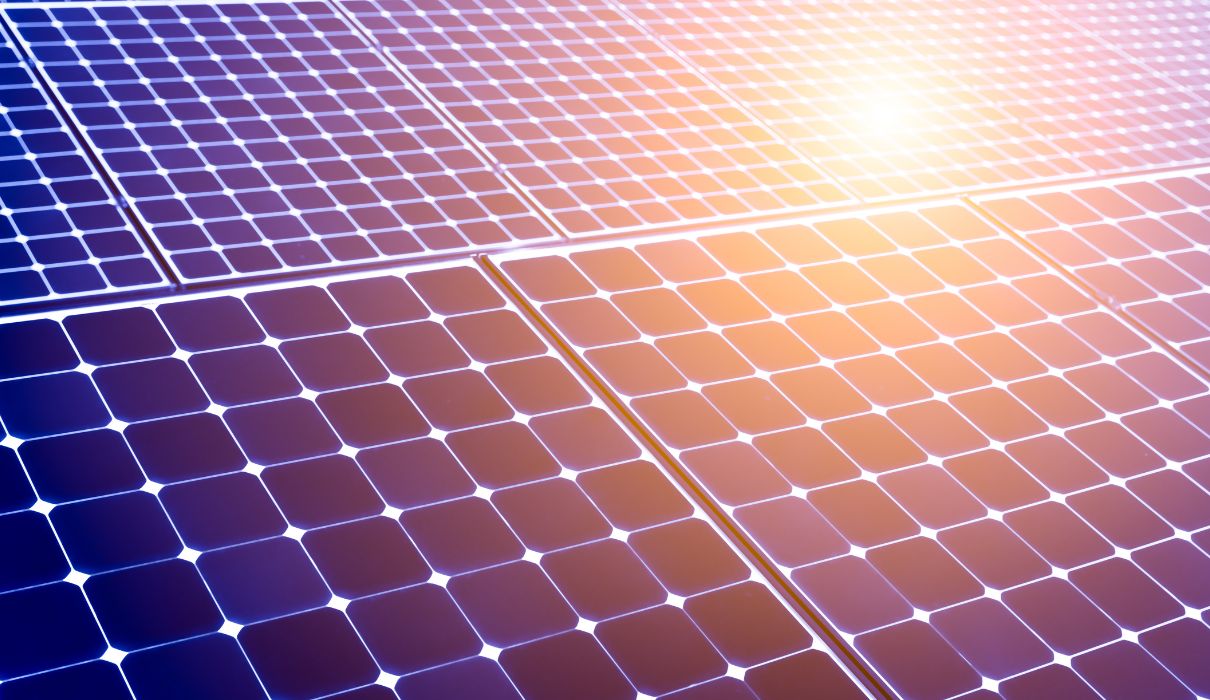
When you look at a panel spec sheet, one of the first things you'll see is the cell type: monocrystalline, polycrystalline, or thin-film. Buyers often ask us which is "best." The honest answer: in 2026, for almost all residential and commercial rooftop use, monocrystalline is the right answer — and the reason why matters less than the practical implications.
The three technologies, quickly
Monocrystalline (mono)
Made from single-crystal silicon wafers. Visually: uniform dark colour, often with a slightly rounded corner on each cell. Highest efficiency (typically 20–23%), best performance in limited space, and price has dropped so much in the last decade that it's now the default choice.
Polycrystalline (poly)
Made from multi-crystal silicon. Visually: blue, speckled appearance. Slightly lower efficiency (16–18%), historically cheaper per watt, but the price advantage has nearly vanished as mono production scaled up. Still sold, but increasingly as the budget option.
Thin-film
Not silicon wafers — deposited as a thin semiconductor layer on glass, metal, or flexible substrates. Lower efficiency (10–13%) but handles heat better, works better in diffuse light, and can be made flexible. Used mostly in utility-scale projects or niche applications (curved surfaces, integrated building materials).
Why monocrystalline won
Three reasons, in order of importance:
- Efficiency means less roof space needed. To make 5 kWp with mono panels takes roughly 10 panels on 18 m². Same output with poly takes ~12 panels on 22 m². On a constrained roof, that matters.
- The price gap has basically closed. Mono used to cost 20%+ more per watt. Today it's often within 3–5%, sometimes cheaper than poly depending on supply conditions.
- Better performance in low light and partial shade. Particularly relevant in Asian climates with monsoon variability.
When poly might still make sense
If you have abundant roof or ground space, no shading issues, and a legitimate price advantage per watt (not just a claimed one), poly can still be a reasonable choice. But we see this pattern rarely in practice — most of the time, poly quotes are just older inventory being cleared out.
When thin-film makes sense
- Utility-scale ground-mount projects where land is cheap and the lower efficiency doesn't hurt.
- Curved or non-standard surfaces that rigid panels can't handle.
- Building-integrated photovoltaics (BIPV) — solar as roofing or facade material rather than add-on hardware.
For standard rooftop residential and commercial, thin-film is almost never the right answer today.
Bifacial panels (which generate from both faces) are typically mono. They make sense for ground-mount installations over reflective surfaces (light-coloured roofs, white gravel, snow) and can add 5–15% to annual output. On standard dark rooftops, the benefit is marginal.
What you should actually focus on
Panel type matters, but much less than:
- Manufacturer tier — a tier-1 poly panel will outlast a tier-3 mono panel.
- Warranty terms — product warranty, performance warranty, and who handles claims matters more than cell chemistry.
- System design — orientation, shading, inverter matching.
- Installation quality — bad installation ruins good panels.
If someone is pushing you hard toward a specific panel type on technical grounds and dismissing other factors — be curious about why.